
The Tale Of Satrajit And The Syamantaka Mani
A tale of a blinding jewel, a false accusation, and a 28-day divine battle that ended in devotion.
TALES OF PURANS
Nir Parikh
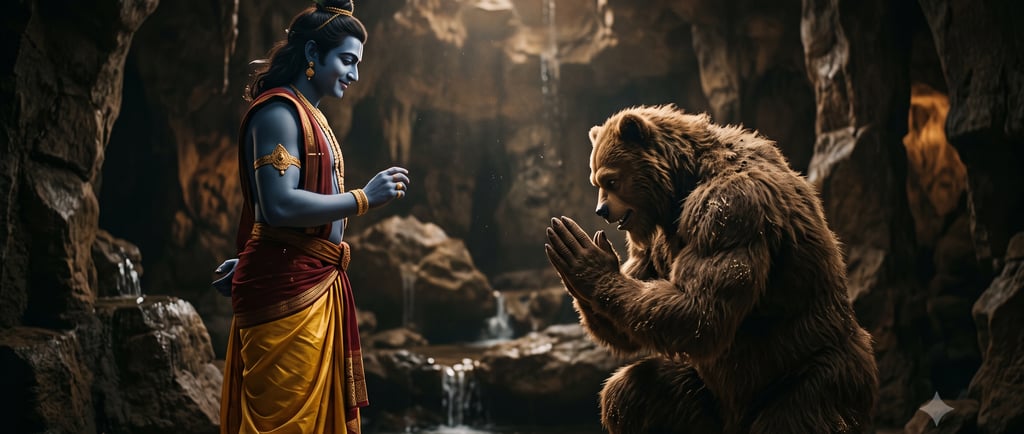
In the vibrant kingdom of Dwarka, under the reign of King Ugrasena and the wise guidance of Krishna, lived a wealthy treasurer named Satrajit. Satrajit was an ardent devotee of Surya, the Sun God. Pleased by years of unwavering devotion, the Sun God manifested before Satrajit and gifted him a dazzling, magical jewel called the Syamantaka Mani. The jewel burned with the brilliant intensity of the sun itself. It possessed immense mystical powers: wherever the stone was kept, that land would never face famine, drought, poverty, or the horrors of war. Furthermore, the jewel miraculously produced an enormous amount of pure gold every single day.
Overjoyed, Satrajit hung the radiant gem around his neck and walked through the streets of Dwarka toward the royal court. The glare from the stone was so blinding that the citizens mistook him for the Sun God himself descending to earth. They rushed to Krishna in awe, exclaiming that Surya Dev had come to visit. Krishna smiled gently and cleared the confusion: "He is not the Sun God. That is Satrajit, wearing the Syamantaka jewel." When Satrajit entered the Raj Sabha (royal assembly), Krishna suggested that a treasure of such immense power and public benefit should be handed over to King Ugrasena. In the king's treasury, the gem could be heavily protected, and its divine abundance could ensure the prosperity of the entire kingdom. (Other accounts suggest Krishna wished to use its power to aid his cousins, the Pandavas, who were suffering through their exile in the forest). However, greed and pride blinded Satrajit. Furious at the request, he flatly refused and took the jewel back to his personal temple.
One day, Satrajit’s brother, Prasanjit, took the jewel from the temple without asking and wore it out into the deep forest for a hunting expedition. While chasing a deer, Prasanjit encountered a fierce lion. The beast attacked and killed Prasanjit, attracted by the glittering stone, and carried the Syamantaka Mani away in its jaws. Shortly after, the lion crossed paths with Jambavan, the immortal king of the bears who had famously helped Lord Rama build the bridge to Lanka generations ago. Jambavan slew the lion, claimed the glowing stone, and brought it back to his hidden cave (an ancient, archaeologically protected cave located in Ranavav, Gujarat, about 17 km northeast of Porbandar), casually giving it to his young child as a shiny plaything. Back in Dwarka, days passed without any sign of Prasanjit or the jewel. Overcome with grief and suspicion, Satrajit began spreading a malicious rumor: "Krishna coveted the Syamantaka Mani, so he murdered my brother in the forest to steal it!" The false accusations tarnished Krishna's reputation and deeply upset the community. Determined to clear his name, Krishna took a small contingent of soldiers and ventured into the wilderness to uncover the truth.
Deep in the woods, they found Prasanjit’s body, showing clear signs of a lion attack. Following the heavy footprints of the beast, they soon discovered the carcass of the lion lying just outside the mouth of a dark, massive cavern. Instructing his soldiers to wait outside, Krishna stepped alone into the depths of the cave. As his eyes adjusted to the dim light, he saw a child playing with the blindingly bright Syamantaka Mani. When Krishna approached, the child grew frightened and began to cry out. Hearing the cries, Jambavan rushed into the chamber, roaring with rage. Seeing an intruder trying to take the toy from his child, the bear king lunged at Krishna.
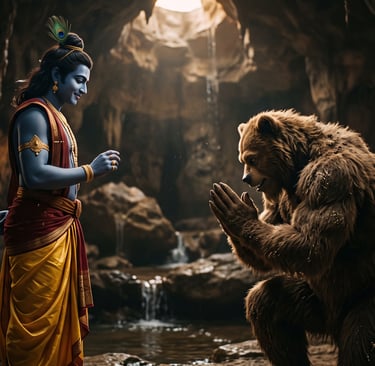
A monumental battle began. Because Jambavan possessed the strength of ten thousand elephants and Krishna was a divine incarnation, neither could easily overpower the other. They wrestled, struck, and parried continuously for 28 grueling days and nights deep within the earth, entirely cut off from the outside world. As the 28th day drew to a close, an exhausted Jambavan felt his strength failing. He realized that no mortal, demon, or ordinary god could match him in physical combat for this long. Suddenly, the veil of illusion lifted. Jambavan looked closely at his opponent and recognized the divine soul standing before him. Failing to his knees, Jambavan folded his hands in reverence. "You are no ordinary man," he wept. "You are my Lord, Rama, the master of the universe, who has returned to earth as Krishna." Krishna smiled warmly, comforting his old devotee, and explained the reason for his journey—the missing jewel and the false accusations that threatened the peace of Dwarka.
Deeply apologetic, Jambavan immediately handed over the Syamantaka Mani. Seeking to seal their eternal bond, the bear king also begged Krishna to accept his beautiful daughter, Jambavati, in marriage. Krishna happily agreed, accepting both the jewel and his new bride. When Krishna returned to Dwarka after 28 days, the citizens—who had given up hope of his return—broke into ecstatic celebration. Hearing the true story, Satrajit was struck with profound guilt and self-loathing for having slandered a divine soul. Desperate to make amends and beg for forgiveness, Satrajit offered Krishna the Syamantaka Mani as a gift, along with the hand of his own virtuous daughter, Satyabhama.
Krishna forgave Satrajit and accepted Satyabhama as his wife, though he insisted that Satrajit keep the jewel in Dwarka to bring prosperity to the land. Through this grand adventure, Krishna cleared his name and returned to the royal palace with two of his principal queens, Jambavati and Satyabhama.
ॐ कृष्णाय वासुदेवाय हरये परमात्मने। प्रणत क्लेशनाशाय गोविन्दाय नमो नमः॥